Infinite-Length Streaming Architecture in InfiniteTalk
How Infinite Talk AI scales sparse-frame video dubbing to practically infinite sequences.
1. Why long-form dubbing is hard
Most audio-driven video models work well on short clips, but start to break down on long sequences:
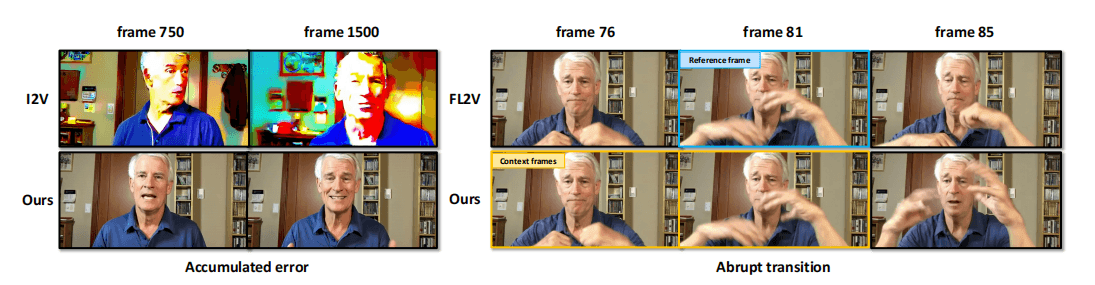
- Identity drift — Faces slowly change shape, skin tone shifts, and backgrounds morph over time.
- Style and color drift — Each segment drifts in color and contrast, making the video look like it was shot on different cameras.
- Visible seams between segments — Models that generate in fixed-length chunks often produce hard cuts in motion: head pose snaps, gestures reset, and continuity is lost.
Naive solutions behave like this:
Plain audio-driven I2V
- Starts from a single reference frame and repeatedly rolls forward.
- Motion is free, but identity and scene drift accumulate.
First–Last-frame-constrained I2V (FL2V)
- Forces each chunk to match a fixed first and last frame.
- Prevents drift, but motion becomes stiff: the model copies poses instead of acting out the audio.
The core challenge:
How do we support long or even "infinite" sequences without sacrificing natural, audio-driven motion?
2. The streaming design of InfiniteTalk
InfiniteTalk is built as a streaming audio-driven video generator specifically for long-form dubbing.
Its architecture is based on two ideas:
- Chunked generation
- The video is divided into fixed-length chunks (e.g., 81 frames per block).
- The model generates each chunk in sequence.
- Context frames + reference frames
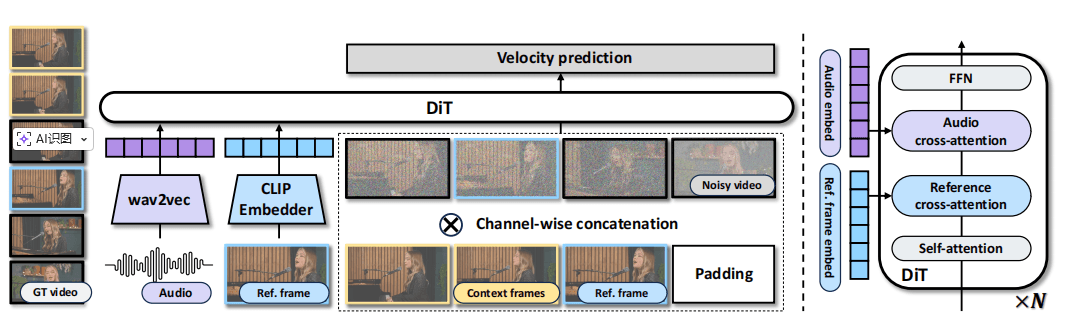
- Context frames: a short history of previously generated frames that carries motion momentum forward.
- Reference frames: sparsely sampled keyframes from the original video that anchor identity, background, and camera trajectory.
This combination lets InfiniteTalk:
- Use context frames to keep motion continuous across chunks.
- Use reference frames to prevent identity and style drift over long durations.
3. Context frames: keeping motion continuous
3.1 What are context frames?
In InfiniteTalk, each chunk does not start from scratch.
Instead, when generating chunk t, the model also sees a short slice of frames from the end of chunk t–1. These frames are called context frames.
- They are taken from already generated video.
- They are re-encoded by the video VAE into latent space.
- They are fed into the diffusion Transformer together with the new audio and reference frames.
Intuition:
If the previous chunk ended with the character raising their head, the next chunk should start from that raised-head pose and continue naturally — not suddenly snap back to a neutral position.
3.2 Example configuration
In the current setup (you can simplify details in the UI, keep them here for technical readers):
- A video is encoded into a latent sequence by a video VAE.
- Each chunk covers 81 frames total.
- The model keeps a latent context length
tc(for example, 3 latent frames derived from 9 context images). - For each step, InfiniteTalk generates 72 new frames, which are appended after the context frames.
Visually, you can imagine:
[Frames 1–81][Context (Frames 73–81)] + [New Frames 82–153][Context (Frames 145–153)] + [New Frames 154–225]Context frames make motion across chunks feel like one continuous take, rather than a set of stitched clips.
4. Reference frames: preventing drift in identity and camera
Context alone only solves continuity; it doesn't guarantee that:
- The actor still looks like themselves.
- The background and camera style match the original footage.
To address this, InfiniteTalk also uses reference frames sampled from the source video:
- These are sparse keyframes selected from the original clip.
- They are encoded into latent features and fed to the diffusion Transformer.
- They act as soft anchors for:
- Face identity
- Clothing and lighting
- Background layout
- Global camera trajectory
During generation, each chunk is conditioned on:
- The dubbed audio for that time range
- The context frames from previous output
- One or more reference frames sampled according to a keyframe strategy
This is what allows InfiniteTalk to sustain:
- Consistent characters across minutes of video
- Stable backgrounds and camera motion
- A coherent visual style, even as the audio and body motion evolve
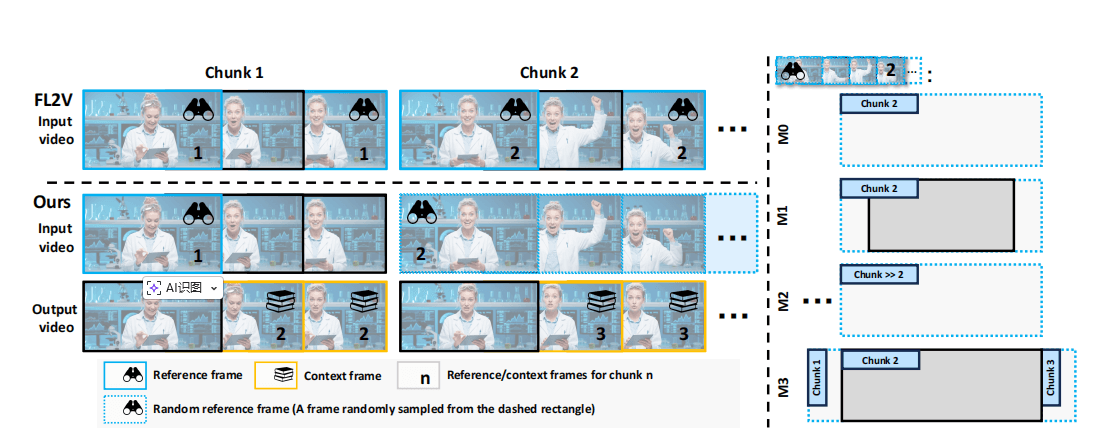
Figure 5: Visualization of reference frame conditioning strategies for video dubbing models. Top four rows: conditioning on input video frames. Bottom row: conditioning on generated video frames. Left: Image-to-video dubbing model with initial frame conditioning (I2V) and initial+terminal frame conditioning (IT2V). Right: Streaming dubbing model with four conditioning strategies. Within each category (left/right), all strategies share identical generated-video conditioning approaches.
(Note: detailed strategies M0–M3 for reference placement are covered in soft-reference-control.)
5. I2V vs FL2V vs InfiniteTalk: architecture comparison
To make the design trade-offs clear, here is a simple comparison:
| Method | Conditions used | Context frames | Long-form issues | Best suited for |
|---|---|---|---|---|
| Plain I2V | Single reference image + previous frame | ❌ | Identity and style drift, motion instability | Short demos, toy examples |
| FL2V | First + last frame per chunk | ❌ | Pose snapping at boundaries, rigid motion | Medium clips with simple motion |
| InfiniteTalk | Sparse reference frames + context + audio | ✅ | Smooth motion, stable identity and camera over time | Long-form dubbing, episodes |
6. From theory to product: how Infinite Talk AI handles long videos
On the product side (Infinite Talk AI), the streaming architecture is used roughly like this:
Per-pass limit
- For practical compute and UX reasons, a single render pass may be capped (for example at ~600 seconds of output).
Chunking and scheduling
- Long audio + source video are segmented into chunks that align with the model's preferred length.
- Each chunk:
- Receives its local audio segment.
- Uses context frames from the end of the previous chunk.
- Shares a pool of reference frames sampled from the full source video.
Stitching
- Generated chunks are concatenated along the timeline.
- Because of overlapping context and soft reference control, seams at chunk boundaries are visually minimal.
In practice, this allows Infinite Talk AI to support:
- Chapter-based workflows (e.g., segmenting a training course or a talk into natural sections).
- Hour-scale programs composed of multiple passes.
- Streaming-style pipelines where content is dubbed in batches but feels like one continuous performance.
7. Why this streaming architecture matters
To summarize:
Naive audio-driven I2V
- Pros: free motion.
- Cons: accumulates drift in identity, style, and background over long durations.
FL2V with hard frame constraints
- Pros: fixes identity drift.
- Cons: introduces pose snapping and stiff motion at chunk boundaries.
InfiniteTalk's streaming architecture combines the strengths without inheriting the weaknesses:
Context frames
Carry motion momentum forward, keeping gestures and head motion continuous across chunks.
Sparse reference frames
Anchor identity, background, and camera trajectory throughout the sequence.
Chunked, audio-driven generation
Scales to virtually unlimited length, while still letting the model act out the dubbed audio naturally.
For creators, this means you can:
- Dub long videos and episodic content without characters "melting" or "resetting" between segments.
- Maintain a consistent visual identity and camera style across an entire series.
- Deliver dubbing that feels like a single take, not a patchwork of disconnected clips.
If you'd like to understand how reference placement and control strength are tuned in InfiniteTalk, continue with:
Soft Reference Control